
Consumer Wearables, Home Sleep Tests and the Future of Screening
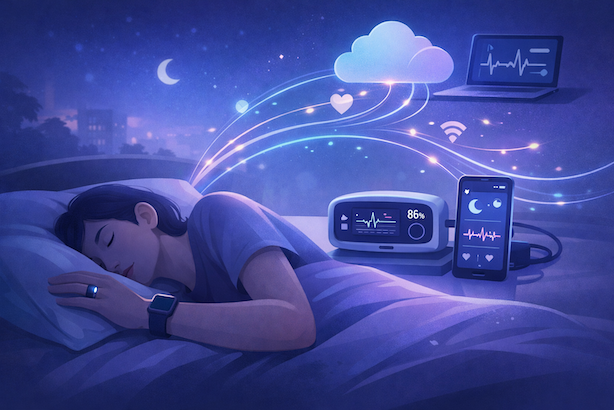
Quick Takeaways
Wearables are conversation starters, not diagnostics: In a 2024 study, Oura Ring beat the Apple Watch and Fitbit for four‑stage sleep classification accuracy by about 5% and 10%, respectively. However, all three devices excelled at detecting sleep vs wake. Use patient‑generated wearable data to engage and educate, while explaining that only professional tests provide a definitive diagnosis.
Major changes to home sleep test (HST) billing are coming: The AMA approved a new HST CPT code set in February 2025 and plans to delete codes 95800, 95801 and 95806, with the new codes slated to take effect on Jan 1 2027. The updated codes better reflect modern home‑based polysomnography systems that capture full sleep architecture and limb‑movement signals.
Home tests are more accessible and data‑rich: Patients can self‑administer tests at home at lower cost than in‑lab studies and even do multiple nights or long‑term monitoring. Still, HSTs are appropriate only for patients meeting specific criteria.
At‑home monitoring is getting smarter: New devices provide SpO₂ trends, sleep staging, pulse variability and event detection, making them indispensable for dental sleep workflows. AI‑powered case‑management systems reduce administrative burden by automating reporting and follow‑ups.
Remote monitoring platforms boost adherence and revenue: Clear Chronic Care’s expanded RPM platform uses cellular devices, automated documentation and personal care advocates to track OSA and cardiometabolic metrics. It helps clinics capture recurring revenue while keeping patients engaged between visits.
Embrace digital ecosystems and educate patients: Integrate wearables, HSTs, AI case‑management and RPM into a unified workflow to reduce friction. Educate patients about their data, set clear triage criteria and highlight multi‑night insights, convenience and modern technology in your marketing.
The sleep landscape is shifting fast. Affordable wearables now gather sleep metrics that patients bring to the exam chair, while home‑based sleep tests have evolved from “good enough” to clinically robust. At the same time, reimbursement models and remote‑monitoring platforms are rewriting how data flows between patients and clinicians. For dental sleep practices, understanding these trends isn’t optional—it’s critical for attracting new patients and building trust with increasingly data‑savvy audiences.
This article explores what consumer wearables can (and can’t) tell you about a patient’s sleep, how the next generation of home sleep tests (HSTs) and remote monitoring platforms are changing care, and how to leverage these tools in your marketing. Whether you’re a dentist just dipping a toe into sleep medicine or a seasoned sleep physician looking to grow, the goal is to arm you with actionable insights.
The wearable revolution: what consumer devices can (and can’t) tell you
Consumer wearables are everywhere. Devices like the Ōura Ring, Apple Watch and Fitbit Sense capture heart rate, movement and sometimes even blood‑oxygen levels. A 2024 study conducted by Brigham and Women’s Hospital compared these devices against gold‑standard polysomnography and found that the Oura Ring outperformed the Apple Watch and Fitbit in four‑stage sleep classification. In fact, the Oura Ring was about 5 % more accurate than the Apple Watch and 10 % more accurate than Fitbit for distinguishing wake, light, deep and REM sleep. The same study noted that while all devices were highly sensitive at distinguishing sleep from wake—with agreement rates exceeding 90 %—the Apple Watch tended to overestimate light and deep sleep.
These findings underscore an important point: wearables provide a reasonably reliable picture of sleep quantity and patterns, but they still diverge from clinical gold standards. Dentists and sleep physicians should treat wearable data as a conversation starter rather than a diagnostic. Here are a few guidelines:
Validate but don’t over‑promise: Explain to patients that wearables offer a useful snapshot of trends over many nights, but they’re not a substitute for professional testing. Use their data to illustrate the importance of seeking a comprehensive assessment when risk factors or symptoms arise.
Contextualize with clinical history: If a patient’s wearable shows frequent awakenings, pair that information with a questionnaire such as the Epworth Sleepiness Scale or STOP‑Bang. Self‑reported symptoms, medical history and an oral exam help determine whether a home sleep test is appropriate.
Highlight the benefits of continuous tracking: Wearables make it easier to monitor lifestyle changes—such as weight loss, alcohol reduction or improved sleep hygiene—and observe their impact. Encourage patients to bring their data to follow‑up visits so you can celebrate progress together.
Patients increasingly expect clinicians to engage with their wearable data. According to Sleep Review, many specialists are grappling with how to integrate consumer‑generated metrics without diluting clinical standards. Transparency is key: be honest about the strengths and limitations of these devices and use them to build rapport rather than to make definitive diagnoses.
Home sleep tests: accessible, multi‑night diagnostics
Home sleep testing has come a long way. The American Medical Association’s CPT panel approved a new code set for home sleep testing in February 2025 and recommended deleting existing codes 95800, 95801 and 95806. If all goes smoothly, the new codes should take effect on January 1 2027. The update is designed to better reflect modern technology, including home‑based polysomnography (hPSG) systems that capture a full array of signals—sleep architecture, limb movements and multiple sleep disorders—equivalent to in‑lab testing. This expansion could make comprehensive home testing more widely available and reduce time to diagnosis.
Why does this matter? As Sleep Review notes, home sleep testing is increasingly popular because it allows patients to self‑administer tests from the comfort of home, often at a lower cost than in‑lab polysomnography. Patients can undertake multiple nights of testing or use an HST as a long‑term monitor, generating richer data about positional apnea, night‑to‑night variability and REM‑dominant events. However, HSTs have limitations: they are clinically appropriate only for patients who meet specific criteria, and they don’t measure every parameter that an in‑lab study does. Clinicians must decide when a home test is sufficient and when a lab study is warranted.
Modern HST devices are also getting smarter. According to the Good Sleep Co’s 2025 trends report, advanced at‑home sleep monitors offer precise metrics such as SpO₂ trends, sleep staging, pulse variability and event detection, making them indispensable for dental sleep workflows. These devices deliver more than just a diagnosis; they support multi‑night variability assessments and help providers fine‑tune titration over time. In short, home sleep tests are evolving from simple screening tools to comprehensive diagnostic instruments.
Remote monitoring platforms: turning data into patient loyalty
Collecting data is one thing; making it actionable is another. That’s where remote patient‑monitoring (RPM) platforms come in. In February 2026, Clear Chronic Care announced an expansion of its Medicare‑focused RPM platform into sleep medicine. The platform integrates remote monitoring and chronic‑care management to track obstructive sleep apnea (OSA) and cardiometabolic indicators. Features include cellular‑enabled devices, automated documentation and personal care advocates to ensure patients stay engaged between visits. By combining remote monitoring with structured care plans and preventive gap identification, the platform aims to help practices capture recurring revenue while improving patient outcomes and audit readiness.
For dental sleep clinics, RPM offers several benefits:
Continuous engagement: By monitoring oxygen saturation, heart rate and sometimes blood‑pressure trends, clinicians can identify residual events or therapy non‑compliance early. This proactive approach helps sustain long‑term adherence, a key factor in treatment success.
Improved chronic‑care management: Many sleep patients have cardiometabolic comorbidities. Platforms that track hypertension and diabetes risk factors and prompt preventive care gaps allow providers to manage OSA within a broader chronic‑care framework.
Alignment with reimbursement models: Medicare’s emphasis on longitudinal accountability means providers who document continuous care may receive better reimbursement. RPM helps automate documentation and ensures clinics are audit‑ready.
In addition to third‑party platforms, the Good Sleep Co highlights that AI‑powered case‑management systems are transforming dental sleep medicine by automating report generation, triage and follow‑up communications. By reducing administrative time and speeding up case turnaround, these systems free clinicians to focus on patient relationships and growth. Digital workflows—from sleep testing to appliance ordering and remote monitoring—are becoming the norm rather than the exception. Practices that adopt them not only improve care but signal to prospective patients that they are modern, efficient and responsive.
Strategies for integrating patient‑generated data into your practice
So how can dental sleep clinics harness wearable and home‑testing data without drowning in numbers? Consider the following steps:
Create a standardized intake process: Ask new patients to share any wearable sleep reports or HST data ahead of their consultation. Use a secure portal or have them email PDFs so you can review trends before they arrive. During the consultation, reference specific data points (e.g., frequent awakenings or low oxygen levels) to illustrate risk factors and the need for professional evaluation.
Establish clear triage criteria: Decide when wearable or HST data warrants a lab‑based polysomnogram. For example, if the patient has complex comorbidities (e.g., heart failure), low nocturnal oxygen saturation or symptoms inconsistent with an HST’s capabilities, recommend in‑lab testing. Document these criteria and communicate them to your front‑office staff so they can set patient expectations.
Leverage digital ecosystems: Integrate HST devices, AI case‑management software and RPM platforms into a single workflow. The Good Sleep Co notes that connected digital ecosystems sync home sleep testing, diagnostic reporting, appliance ordering, communication and follow‑up. Such integration reduces friction, improves data visibility and enhances the patient experience.
Educate patients on data interpretation: Patients may misinterpret wearable metrics. Offer short educational videos or handouts explaining what sleep stages mean and why certain events (e.g., micro‑arousals or desaturation dips) matter. This empowers them to have informed discussions and reduces anxiety about conflicting data.
Close the loop with follow‑up: Remote monitoring is most valuable when paired with active follow‑up. Schedule brief check‑ins (virtual or in‑person) to review HST results, adjust therapy and discuss wearable trends. Patients who feel supported are more likely to adhere to therapy and refer friends, strengthening your practice’s reputation.
Marketing messages that resonate in a data‑driven era
Integrating consumer wearables and HSTs isn’t just good medicine—it’s a powerful marketing differentiator. Here’s how to communicate your embrace of modern screening tools:
1. Highlight objective evidence in your content. Patients increasingly expect proof of effectiveness. On your website and social media channels, showcase case studies where wearables and HST data informed diagnosis and led to successful treatment. For example, share a story about a patient whose Oura Ring data revealed frequent REM‑related apnea events and how a multi‑night HST confirmed the diagnosis.
2. Use multi‑night insights as a selling point. Stress that modern HSTs allow multiple nights of data collection, leading to more accurate diagnoses and tailored therapy. Use visuals or infographics to show how multi‑night data reveals positional or REM‑dominant patterns that one‑night tests might miss.
3. Emphasize convenience and comfort. Patients appreciate the ability to test at home at a lower cost. Position your practice as patient‑centric by offering home kits, remote coaching and in‑app tutorials. Reassure them that you still adhere to clinical guidelines and will recommend in‑lab studies when necessary.
4. Showcase your digital ecosystem. Explain that your practice uses AI‑enabled case management, 3D scanning and remote monitoring to streamline each step of care. This signals efficiency and modernity to potential referrers and patients. Include screenshots of your digital platform (without revealing sensitive data) in blog posts or webinars.
5. Engage on social media around trending topics. Comment on news about new wearable features, HST code updates or remote monitoring advances. Educate your audience about what these developments mean for them and invite questions. This positions you as a thought leader and increases organic reach.
Call to action: prepare for the future of screening
The intersection of consumer wearables, home sleep tests and remote monitoring is redefining how sleep apnea is detected and managed. Patients are no longer passive recipients of care; they arrive armed with data and expect clinicians to interpret it. By embracing modern screening tools, dental sleep practices can build trust, improve outcomes and stand out in a competitive market.
To help you integrate these trends into your practice, Sleep Acquisition has created a home‑testing integration checklist that covers everything from patient intake and device selection to marketing messaging and follow‑up workflows. Download the checklist and book a free strategy session with our team to learn how we can attract data‑savvy patients to your clinic.
The future of sleep screening is already here. Clinics that adapt now will not only deliver better care but also build sustainable growth in the years to come.


